A Child Caught In The Middle: Triangulation In The Family
Today, Kelly wants to talk with you about triangulation in the family.
Horror Story In A Child’s Eyes
A couple drove out one evening, leaving their young son home alone.
That night, the boy heard a radio report about a car accident, and he grew very worried.
At that very moment, his parents walked back through the door.
His father said sorrowfully, “Your mother died in the crash. I was the only one who survived.”
His mother told him, “Your father is dead. I’m the only survivor.”
The little boy looked at the two people in front of him, terrified:
Which one of them is telling the truth?
Then things got stranger still.
When his father took the boy out to play, he acted as though his mother weren’t there at all. When his mother cooked dinner, she made only two portions, completely blind to the father sitting right across from her. Both of them spoke only to their child, and treated the other as if they were invisible.
Gradually, the boy understood:
His parents couldn’t see each other—but he could see both of them.
Later, while spending time with them, the boy let this secret slip.
What followed were furious arguments.
The boy shuttled back and forth between his parents, carrying their hurtful words:
“Good riddance—you’re gone.”
“I’m so happy I can’t see you anymore.”
Little by little, the curses escalated. The tone on both sides turned more and more vicious.
Finally, unable to bear the pressure, the boy fainted.
When he woke up, he found he could no longer see both his mother and father at the same time.
Torn between the two, the boy chose to live with his mother—and from that day on, he never saw his father again.
The Truth Behind the Metaphor
This story comes from a Japanese film, Five Stories About Going on Living.
At the end of the film, the mother takes the boy to see a doctor, and the truth is finally revealed:
There was never any car accident. There was no supernatural plot twist, either.
All of it was a metaphor:
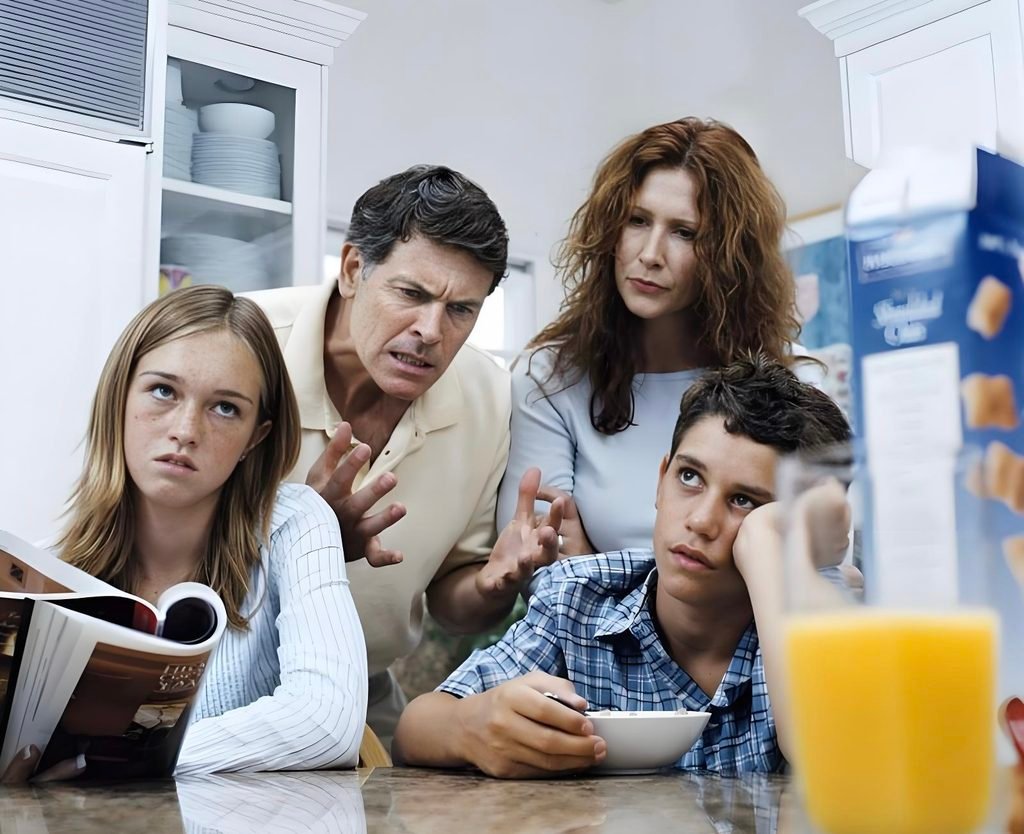
The boy had once had a happy family. But his parents’ relationship had deteriorated, and they fought—arguing and even coming to blows.
At first, they gave each other the silent treatment, pretending they couldn’t see one another. Then the boy, caught in the middle, became their messenger. In the end, he was forced to pick a side and make his own “choice.”
It turns out that in a child’s mind:
A toxic home atmosphere created by parents fighting and freezing each other out is as frightening and suffocating as a horror film.
And this is what countless real families look like:
Clearly a conflict between two adults, yet an innocent child gets dragged into it.
The child becomes the one painfully “stuck in the middle.”
What Is Triangulation In The Family?
In psychology, this phenomenon has a name: triangulation in relationships.
The concept was developed by American psychiatrist and family therapist Murray Bowen. It refers to this: when a relationship between two people runs into trouble, one or both of them bring in a third party to diffuse the direct conflict between them, temporarily stabilizing the relationship.
It happens all the time in real life.
A couple is in the middle of a fight. Just as they’re about to touch on the core issue and emotions are about to boil over, they suddenly stop talking to each other—and pull the child in, saying with great anguish:
“Honey, what do you think we should do?”
“Honey, tell me, isn’t that right?”
This lets them avoid confronting each other directly, while still sending messages to one another through the child.
Seen this way, “triangulation” does offer certain benefits to the two people locked in conflict.
But it ignores the third person in this “war”: the child.
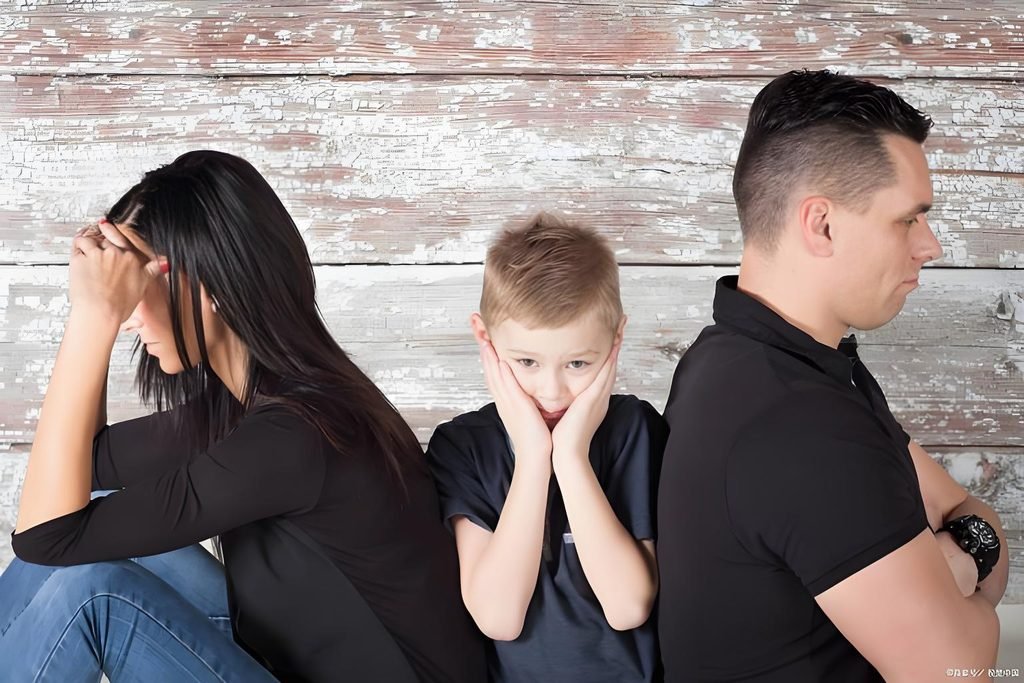
If, among the three, the child is consistently used as a tool for the other two to resolve their conflicts or attack each other, then in this relationship, the child has been triangulated.
We all know that parents fighting affects a child’s mental health. But the root cause of the damage isn’t the fighting itself—it’s this triangulated relationship.
What Triangulation In The Family Does to a Child
1. Carrying Pressure That Was Never Theirs
One person shared her experience online:
“For years it was as if I were holding a dictionary with all the definitions twisted. The synonym for ‘I love Mom’ was ‘I hate Dad.’ The synonym for ‘I want Mom to be happy’ was ‘I never want to see Dad again.’
My mother was hurt by my father in that marriage, and I was to be the blade used to punish him. It was as if a thirty-six-year-old woman trapped in an unhappy marriage already lived inside my eight-year-old body. I hadn’t even held a boy’s hand yet, but I had to chew over the filth of a failed marriage alongside my mother.
At the worst of it, my mother forbade me from calling him ‘Dad.’ She said since the man wouldn’t pay to support me, there was no need to call him that. When I was in sixth grade, I got seriously ill and was hospitalized. My father called the hospital, and my mom happened to be standing right there. I had a high fever, and while holding the phone, I kept sneaking glances at her face. She glared at me with a furrowed brow, and I couldn’t get that word ‘Dad’ out.
After I hung up, I thought for the first time that it might be better to just die of this illness—there would be so much less trouble.”
These words speak for so many children:
When parents turn on each other, children blame themselves to the point of wishing they were dead.
Because whichever side you lean toward means betraying the other.
And if the child is then treated as a bargaining chip and forced to choose, to take a side, it produces intense pain and inner division.
This is textbook triangulation in the family.
Both parents “value” the child highly; both want to win the child’s attention and affection. At that point, the child is elevated to a powerful position, becoming the source and symbol of parental power.
A child in that position suffers deeply. They’re torn; they walk on eggshells, terrified that something they say or do will become the spark for their parents’ conflict.
Their parents’ conflicts and emotions all seem to become the child’s own problem.
“I’m like my parents’ boxing gloves. It looks like they’re hitting each other, but really, they’re both hitting me.”

2. Somatization of Depressive Symptoms
This is another common occurrence in triangulated children.
Take this real case:
Alex’s father was an alcoholic, and his mother despised him for it.
Alex agreed with his mother. He never asked to see his father, and acted as though he held his father in contempt.
But as an adult, alcohol gained an inexplicable hold over him. He couldn’t resist the urge to drink, and often drank himself into a stupor.
Every time his mother scolded him, Alex felt ashamed and full of remorse—but he couldn’t change.
Later, a therapist helped Alex find the reason for his drinking:
Deep down, he longed for his father’s acceptance. And drinking was his father’s most defining trait—so by drinking, he was declaring that he was still his father’s son.
For a child to grow up, they must internalize part of their mother and part of their father.
But when parents are locked in long-term discord—to the point of becoming enemies—the child’s experience is one of splitting and self-warfare.
When a child cannot “mentalize” or “put into words” their fear and insecurity, they can only “somatize” and “act out.”
So when a child develops physical symptoms or “problem behaviors” that don’t improve for a long time, parents should be on alert. Pressuring the child directly probably won’t help; instead, attention should go to repairing the relationships—between the parents and between the parents and the child.
When the relationships improve, many of the child’s problems resolve on their own.
3. Never Fully Growing Up or Separating
The psychologist John once described a client whose parents frequently fought and gave each other the silent treatment, and who had always served as the messenger between them.
Whenever she fought with her father, her mother would say to her:
“Go talk to your father.”
Loyally and painstakingly, the little girl would convey her mother’s moods and feelings to her father, along with all sorts of reasoning about how “husband and wife ought to get along.”
After listening, her father would either fly into a rage, arguing with her and dumping all his accumulated anger and resentment onto her, or simply say: “Go tell your mother all that.”
And she’d have to go back and report to her mother.
She felt powerless and suffocated—like a bridge. Whatever problems they had had to pass through her, and she never once questioned whether this role of hers was right. She simply accepted it as a matter of course.
John said to her:
“Do you know the biggest problem with being a bridge? A bridge is fixed in place. It can’t find its own path. Because the bridge knows that if it leaves, the two ends will become two isolated islands.”
Children who have been triangulated in their family for years struggle to go out and build a world of their own. Unconsciously, they believe they must stay inside the family, forever serving as the bond holding their parents together.
What’s worse, such a child is forced to constantly manage their parents’ emotions and balance their parents’ conflicts. They never get to be a child—instead, on a psychological level, they become their parents’ parent. Growing up, it’s hard for them not to loathe weakness and vulnerability in others.
Especially in intimate relationships.
When a partner is physically unwell or emotionally fragile and wants to lean on them, they feel utterly annoyed and crushed by the pressure and push the other person away.
They were over-relied upon by their parents as children, so they’ve long since come to hate anyone who depends on them or uses them.
Because parents are “family,” the hatred gets rationalized; the child never becomes conscious of it. In adulthood, that hatred gets directed at the person in an intimate relationship who wants to depend on them.
Sometimes, negative emotions can actually be a way for partners to deepen understanding and intimacy. But a child who was triangulated grows up fearing and avoiding emotional fusion.
Because emotional fusion, to them, means being exploited.

Give the Conflict Back to Your Parents
Bert Hellinger once said: “A child’s love is infinite… To be bound to their parents through suffering is, for them, an enormous temptation.”
But what you need to do, reading this now, is this:
Give the conflict back to your parents.
Tell yourself: however they resolve their conflicts, and however much you care about both sides of this war, this is not your war.
Don’t rescue your parents by consuming yourself. Don’t feel guilt or self-blame for their miserable lives, their unhappy fate.
You are not the reason their lives failed. Without you, their lives would have been just as bad.
Try turning in a different direction: rescue yourself.
If this family system cannot protect you, then your priority is:
Leave that system, and protect yourself—the first casualty here.
A person with anemia cannot donate blood.
If you have strength to spare someday, you can try to influence your parents.
But while you yourself are still depleted, don’t squeeze yourself dry to be your parents’ emotional sustenance.
Love yourself first.