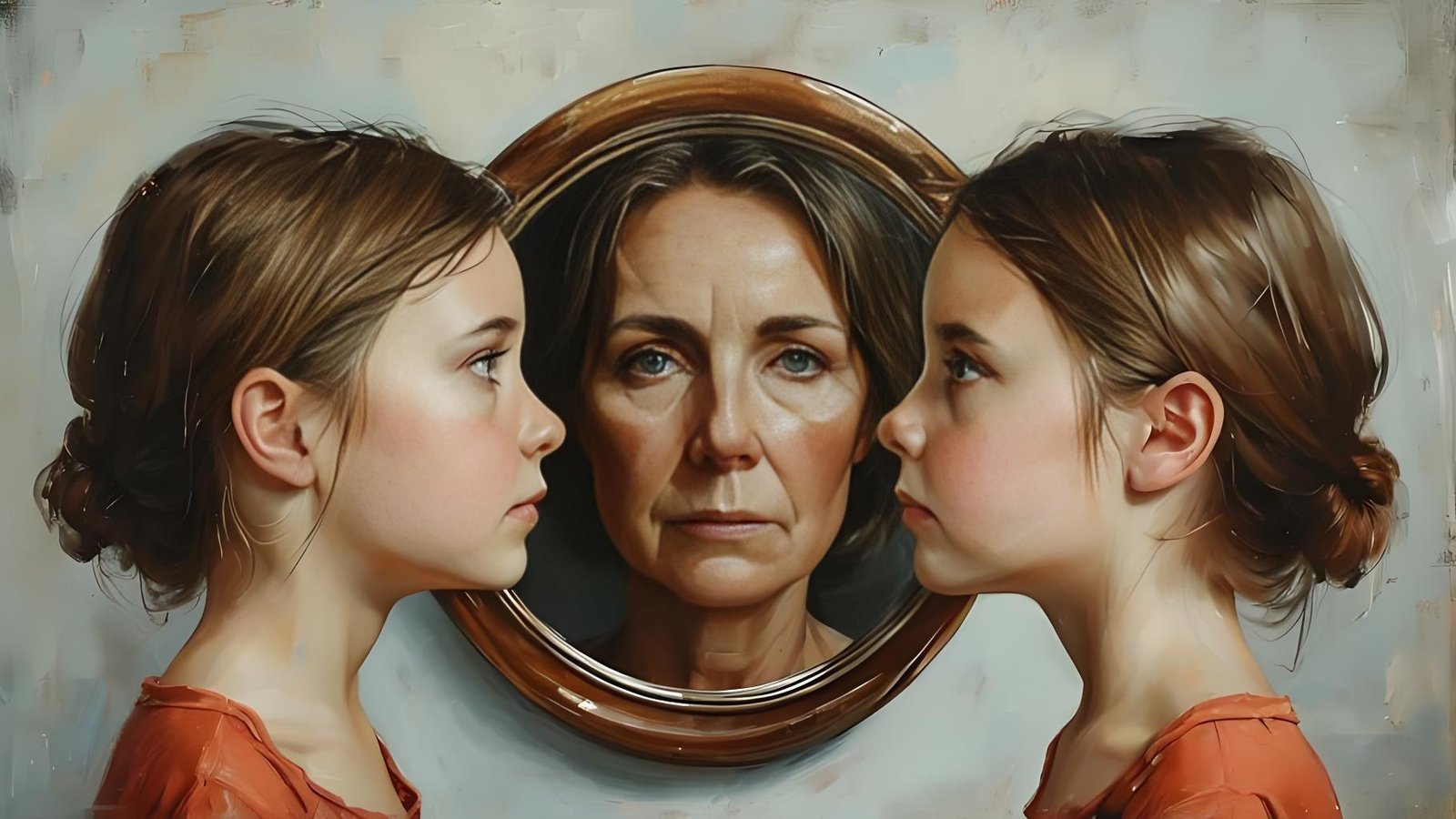
Your Relationship With Your Mother Holds The Key To Your Future.
Your Future Is Forged in the Mother-Daughter Relationship
Some say, “My mom is my safest harbor—my strongest backbone.”
One woman shared her story online: after working for a few years, she decided to quit her job and pursue a PHD.
Her mother didn’t question or discourage her. Instead, she sat down, listened carefully, and said,
“Go. Mom supports you in seeing a bigger world—and I can’t wait to hear all about it when you come back.”
Though money was tight at home, her mother quietly transferred her entire savings—meant for her own retirement—into her daughter’s account. All because she couldn’t bear the thought of her child suffering even the smallest hardship.
But others say, “My mother’s love feels so heavy, I can barely breathe under its weight.”
Another woman described her daily life with her mom. She tries to check in—asking what her mother did today, whether she’s happy.
But within minutes, the conversation turns: her mother begins unloading her own pain—her unhappy marriage, financial stress, health issues, endless chores…
Every time, her daughter ends up feeling like a guilty criminal—as if her failure to give her mother a better life is exactly why her mom is suffering.
Two mothers. Two kinds of love.
So why is it that, even within the same bond of “mother and daughter,” the way they relate to each other can feel worlds apart?

Two Distinct Mother-Daughter Relationship Patterns
Because of this, mother-daughter relationships can generally be grouped into two distinct patterns:
1. The Mother Who Supports and Lifts Her Daughter Unconditionally
John Bowlby’s attachment theory suggests that the mother-daughter bond is a natural emotional tie—a form of symbiotic attachment. This closeness provides the daughter with emotional and physical security in her early years, while also nourishing the mother herself, helping her find identity and purpose in her maternal role.
Mothers in this category may see their daughters as an extension of themselves, yet what sets them apart is this: they hope their daughters, once equipped with essential life skills, will bravely become their own person.
I once came across a story about a little girl named Longlong, who loved baking. She spent her free time making bread, and her dream was to open her own bakery one day. During the pivotal summer before starting middle school—when most of her peers were buried in tutoring classes—she told her mother she didn’t want extra lessons; she just wanted to bake at home.
In many families bound by the belief that children must excel academically, such a wish might have been dismissed as “frivolous” or “unrealistic.” But after careful thought, Longlong’s mother chose to respect her daughter’s wishes:
“Let her grow up lightheartedly, doing what she loves. Everything else—we won’t force it.”
Building on this, Japanese counselor Sakaita Tamaki offered further insight into the “embodiment” of the mother-daughter bond:
An emotionally mature mother, capable of healthy self-regulation, is keenly aware that her daughter is an independent subject, not merely an extension of herself. She adjusts her expectations and parenting style as her child grows, meets her daughter with deep empathy, and strives to offer unconditional support.
Such a mother not only builds a safe harbor for her daughter emotionally, but also clears the skies for her to explore life freely. She teaches her daughter, through both words and actions, that she is allowed to live as a whole person—guided by her own desires, not someone else’s blueprint.

2. Hidden Conflict and Competition In Mother-Daughter Relationship
Psychologist Karen Horney, in Feminine Psychology, observed that, influenced by the Oedipus complex, a subtle yet enduring competitive dynamic often exists between mothers and daughters.
Mothers in this pattern tend to see their daughters less as children and more as rivals—measuring themselves against her, often without realizing it.
A former classmate of mine, Flora, experienced this firsthand.
When she failed an exam, her mother would say she wasn’t as smart as she had been at that age. When she did well, her mother would remark that she still had plenty of room for improvement compared to herself back then.
If Flora lost weight, her mother might casually add, “When I was your age, I was much slimmer than you are now.”
When work troubles arose, her mother’s response was cool and detached: “If I were you, I’d have figured out a solution ages ago.”
The rivalry became especially clear in Flora’s interactions with her father. Whenever she and her dad shared a warm, affectionate moment, her mother would respond with a sharp edge of resentment:
“So close to your dad, huh? Guess all that raising I did was wasted on you.”

Horney suggested that such competitive behavior often stems from the mother’s fragile sense of self. When a mother feels deeply insecure, she may unconsciously try to block her daughter’s growth through fear, ridicule, or belittling remarks—particularly around the daughter’s emerging charm or independence.
It’s not that she doesn’t love her daughter; rather, she lacks the capacity to love in a healthy, nurturing way.
Building on this, psychologist Susan Forward, in Mothers Who Can’t Love, notes that many mothers, due to their own psychological or emotional limitations, are unable to provide their children with consistent, unconditional love.
Instead, they view their daughters through the lens of their own experiences, impose rigid family rules, and project their own unfinished dreams onto their children—secretly wishing their daughters could live the life they never had.
From this perspective, the comparisons, complaints, and control aren’t merely conflict—they are misguided attempts to “shape” the daughter into the woman the mother wishes she herself could have been.

Two Kinds of Mothers, Two Kinds of Destinies
The way a mother treats her daughter quietly but powerfully shapes how that daughter sees herself—and the world.
On one hand, a daughter raised in uplifting love is likely to enjoy the following positive life experiences:
1. The Daughter Raised in Uplifting Love
A daughter nurtured in unconditional support often develops a deep, unshakable sense of self-love and confidence.
Heinz Kohut’s 《Self Psychology 》 suggests that we form our sense of self largely through the reflections we receive from significant others—especially our primary caregivers. For a daughter, her mother is the first and most influential mirror.
When a mother offers genuine care and encouragement, her daughter naturally internalizes messages like:
“I am good. I am worthy of love. My feelings matter.”
These early experiences become the bedrock of a strong, positive self-image—one that colors every relationship she will ever have.
In the Korean drama When Life Gives You Tangerines, the character Aejung embodies this kind of motherhood.
When her in-laws tried to train her daughter Geum-myeong to become a haenyeo (a laboring female diver), Aejung overturned the table and declared:
“This is my daughter—not someone’s breadwinner.”
When Geum-myeong considered giving up studying abroad because of financial strain, Aejung sold their only home to fund her education.
And when, during a formal meeting with her future in-laws, Geum-myeong was expected to serve them humbly, Aejung stepped forward and told the groom’s mother plainly:
“We won’t teach her to do those things—because she is our most precious treasure.”
It was this mother’s unwavering love that allowed Geum-myeong to grow into a woman who was emotionally rich and spiritually whole.
So when her boyfriend asked her to sacrifice for love, she could say—clear-eyed and firm:
“I love you. But I also love myself deeply.”

2. The Desire—and Capacity—to Become a Good Mother
Social Learning Theory tells us that human beings learn how to navigate the world largely by observing the behaviors of significant others.
For a daughter, her mother is the very first—and most powerful—female role model. The way her mother cares for her becomes the blueprint for how she will one day mother her own children.
As counselor Hou Yuzhen notes, a daughter’s identification with her mother profoundly affects not only her sense of female identity, but also her ability to become a nurturing, competent mother herself.
In When Life Gives You Tangerines, Aejung is widely seen as an “ideal mother.” But that ideal was made possible because she herself was deeply loved by her own mother, Gwang-rye.
Gwang-rye was a haenyeo, a freediver facing the sea’s dangers daily. Her family was weighed down by debt, her husband was in poor health, and their household of five rested heavily on her shoulders.
Yet in the face of relentless hardship, she never complained. Instead, she told young Aejung:
“It is I who am pitiful—not you. Don’t shrink back. Live your life to the fullest.”
She insisted on sending Aejung to school, refusing to let her daughter follow her into the sea. She fought, however she could, to create a safe space for her child to grow.
That unconditional love—fierce, self-sacrificing, and unwavering—became Aejung’s own template for motherhood. Having been cherished, she knew how to cherish. And so she, in turn, raised Geum-myeong to be a woman of self-respect and quiet strength.
In the end, it became a chain of intergenerational uplift—spoken so beautifully in the drama’s refrain:
“Grandma swam in the sea. Mother ran on the land. And I—I get to fly in the sky.”

On the other hand, a daughter raised in the shadow of maternal competition may face a very different fate:
1. Failure of Individuation: Believing You Are Unworthy of Love
Psychologists Margaret Mahler and her colleagues argue that excessive conflict between mother and daughter can lead to a failure of individuation—meaning the daughter is unable to develop a stable, independent sense of self.
A daughter in this situation often lives in a state of constant self-censorship.
Even a small desire—such as wanting to eat a loaf of bread—can trigger endless inner deliberation:
“Will Mom be upset if I ask for this?”
To avoid conflict, she chooses silence, tucking her needs and thoughts away where no one can see them.
At the same time, she becomes hyper‑attuned to her mother’s emotional needs, feeling responsible for being her mother’s emotional anchor—sometimes slipping unconsciously into the role of a “parental partner.” Yet she cannot possibly carry such an unrelenting emotional load.
Over time, this chronic self‑suppression erodes her sense of self‑worth.
Social psychologist Erik Erikson described this mechanism as “negative identity formation”:
Because she was never truly loved, she does not know how to love herself. She cannot believe she is inherently worthy of care. Before she even has the chance to become herself, she has already learned to deny herself.

2. Repeating Familiar Patterns in the Shadow of Your Mother
Psychologist John Bowlby also believed that the mother–daughter relationship is a daughter’s very first—and most influential—“relationship template.”
When this template is marked by control, emotional distance, or distrust, a daughter is likely to unconsciously fall into one of two traps in her future romantic relationships: either fearing intimacy or exerting excessive control.
What’s even more disheartening is that, without realizing it, she may end up mirroring her mother’s behavior—replaying the same dynamics her mother had with her father.
My friend Luna knows this all too well.
Her mother was highly controlling: from meals to clothing, every detail of family life had to follow her arrangements. And she never missed a chance to criticize Luna’s father.
As an adult, Luna was horrified to discover that she treated her boyfriend in almost exactly the same way.
On a trip together, she micromanaged every detail of the itinerary. Any suggestion from him irritated her. In daily life, she found herself picking faults with him constantly.
She realized, with exhaustion and disgust, that she had unconsciously become her mother—living out the very patterns she had grown up resenting.
As Chizuko Ueno puts it, mothers and daughters are mirrors of each other. A daughter cannot love the parts of herself that resemble her mother, yet she cannot fully escape her mother’s imprint either. That inner, torn sense of self becomes a lifelong struggle for many women.

How Should a Daughter Raised in Maternal Conflict Find Her Place
When a mother’s love comes tangled with endless venting and emotional weight, you—as her daughter—often find yourself caught between compassion and exhaustion. You want to ease her pain, yet you feel your own energy slowly draining away.
If this dynamic has left you feeling depleted, here are three directions that may help you reclaim your calm and strength:
1. Dialogue with the “Inner Mother” and Seek Internal Reconciliation
If your mother is truly unable to meet your needs for love, please know: this is not your fault, nor is it entirely hers.
More often than not, she herself is constrained by her own upbringing and emotional capacity. She simply hasn’t learned how to express care in healthier ways—and that does not mean she doesn’t love you at all.
Try, in your mind, to see her as a whole person with limitations—rather than only through the lens of “mother.”
Shift your thinking from “A mother should…” to “This is all she is capable of right now.”
This subtle cognitive shift can be a quiet liberation for your heart.

2. Become Your Own Guardian: Re-Parent the Little Girl Within
The validation, warmth, and security you didn’t receive from your mother in childhood can, in adulthood, be gradually repaired through other relationships.
This process is known as a “corrective emotional experience”—rebuilding your perception of relationships and your beliefs about love by forming new, healthy emotional bonds.
You can intentionally seek out friends, partners, or family members who offer genuine attention and understanding. Even the companionship of a pet can provide a sense of unconditional presence.
Through these interactions, you slowly accumulate experiences of being seen and respected.
No one can replace your mother—but you can diversify your sources of emotional nourishment, and relearn, step by step, what it feels like to be loved well.
3. Between Love and Boundaries: Find Your Safe Distance
You might try expressing your feelings to your mother with gentleness and firmness, such as:
“Mom, I care about you deeply, but I also have my own emotions to tend to. Could we sometimes talk about lighter things too—or focus on how to make things better together?”
Be prepared: she may not adjust right away. She might even misinterpret your honesty as blame or rejection.
If that happens, you can consciously adjust the frequency of contact, gently guiding both of you toward a new rhythm of relating.
Setting boundaries isn’t about pushing her away.
It’s about protecting your right to remain whole—and at peace—within the relationship.