What Is Cognitive Psychology?
Abstract
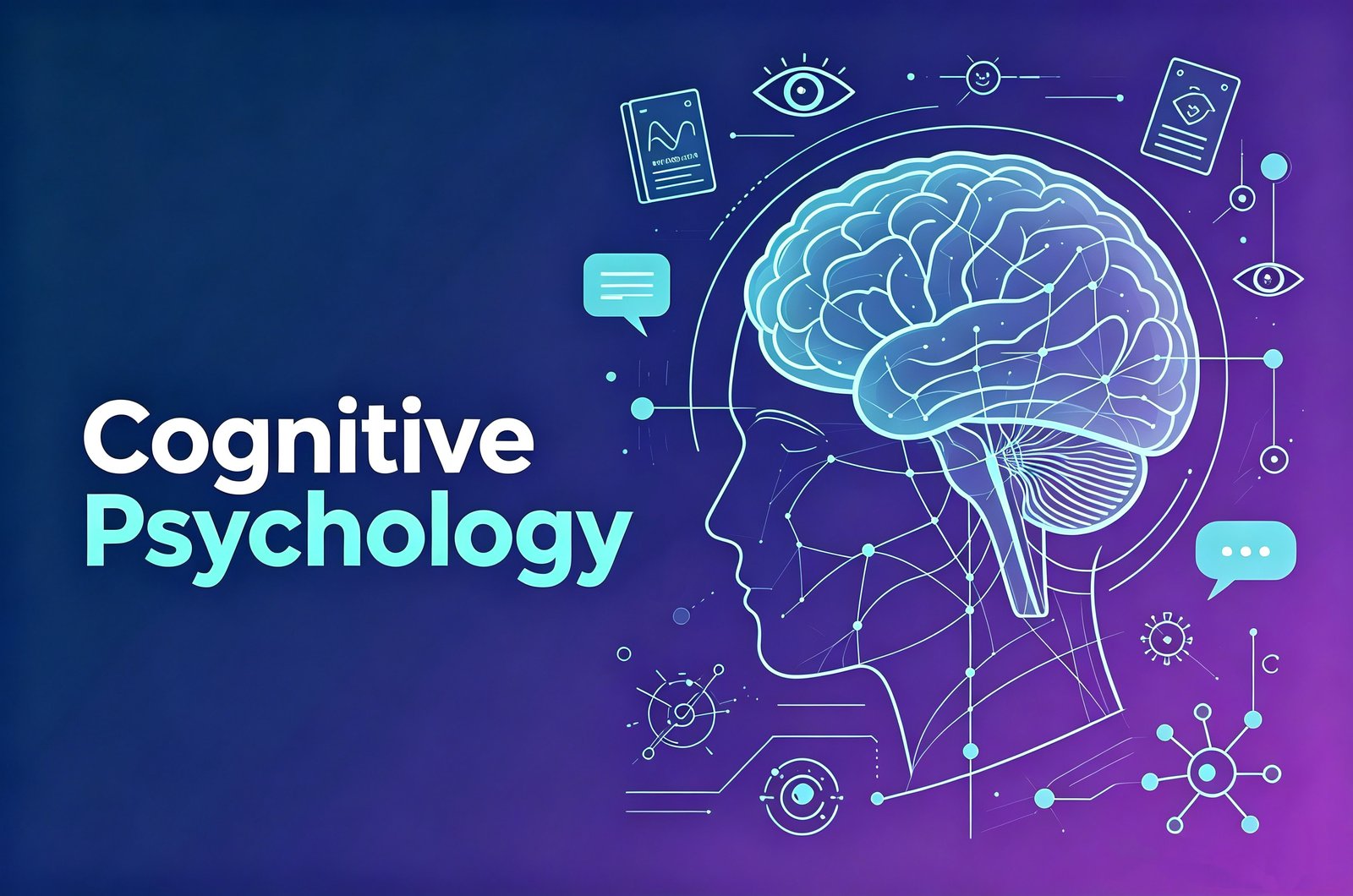
Cognitive Psychology is the scientific study of internal mental processes—including perception, memory, attention, language, problem-solving, and decision-making. Emerging in the mid-20th century as a reaction to Behaviorism, this discipline treats the mind as an information processor, drawing parallels between computational systems and human cognition. This article provides a professional overview of the historical context, core domains, research methodologies, and contemporary applications of cognitive psychology, highlighting its pivotal role in understanding the architecture of the mind.
Introduction: The Cognitive Revolution
For much of the early 20th century, psychology was dominated by Behaviorism, which dismissed the study of consciousness as unscientific. However, by the 1950s and 60s, a paradigm shift known as the Cognitive Revolution began. Scholars like Ulric Neisser (who coined the term “Cognitive Psychology” in 1967), George Miller, and Jerome Bruner argued that to understand behavior, one must understand the mental processes that mediate between stimulus and response.
Cognitive psychology views the mind as a processor of information, much like a computer: it encodes input, manipulates symbols, stores data, and retrieves it to guide action. This computational metaphor remains a foundational concept in the field.
Core Domains of Study
Cognitive psychology is organized around several interrelated domains:
1. Perception
Perception involves interpreting sensory information to make sense of the environment. It bridges the gap between raw sensation (bottom-up processing) and prior knowledge (top-down processing).
- Key Topics: Pattern recognition, Gestalt principles, depth perception, and perceptual constancy.
- Application: Understanding visual illusions helps reveal how the brain constructs reality.
2. Attention
Attention acts as a filter for the vast amount of information available to our senses.
- Key Models: Broadbent’s Filter Model, Treisman’s Attenuation Theory, and the concept of “Selective Attention.”
- The Cocktail Party Effect: The ability to focus on a single conversation in a noisy environment while still monitoring one’s name being called in the background.
3. Memory
Memory is perhaps the most studied area in cognitive psychology. It is typically divided into three main stages:
- Sensory Memory: Brief preservation of sensory information (e.g., iconic and echoic memory).
- Short-Term / Working Memory: Limited-capacity storage where information is actively manipulated (Baddeley’s Model of Working Memory includes the phonological loop and visuospatial sketchpad).
- Long-Term Memory: Relatively permanent storage, subdivided into:
- Explicit (Declarative): Episodic (events) and Semantic (facts).
- Implicit (Non-declarative): Procedural (skills) and Priming.
4. Language
Cognitive psychologists study how humans acquire, comprehend, and produce language.
- Key Concepts: Phonetics, syntax, semantics, and pragmatics.
- Theories: Noam Chomsky’s theory of Universal Grammar and the debate between Nativism (innate structures) and Empiricism (learning through exposure).
5. Problem-Solving and Decision-Making
This domain explores how we navigate novel situations and choose between alternatives.
- Heuristics: Mental shortcuts (e.g., Availability Heuristic, Representativeness Heuristic) that ease the cognitive load but can lead to biases.
- Biases: Systematic errors in thinking, such as Confirmation Bias or Anchoring Bias (extensively studied by Tversky and Kahneman).
Research Methodologies
Cognitive psychologists employ a variety of experimental methods to infer mental processes:
- Reaction Time (RT): Measuring the speed of responses to stimuli to infer the duration of cognitive operations.
- Eye-Tracking: Monitoring gaze patterns to understand visual attention and reading processes.
- Neuroimaging: Using fMRI (functional Magnetic Resonance Imaging) and EEG (Electroencephalography) to observe brain activity during cognitive tasks.
- Computational Modeling: Creating algorithms and neural networks that simulate human cognitive processes.
Applications in Professional Practice
1. Cognitive Neuroscience
The intersection of cognitive psychology and neuroscience has led to Cognitive Neuroscience, which maps cognitive functions onto specific brain structures (e.g., the role of the hippocampus in memory consolidation).
2. Human-Computer Interaction (HCI)
Understanding cognitive load, attention limits, and memory constraints informs the design of user-friendly interfaces, websites, and software (UX design).
3. Cognitive Rehabilitation
Following brain injury or stroke, cognitive psychologists develop interventions to retrain attention, memory, and executive functions.
4. Education
Insights into how working memory affects learning have led to strategies such as “chunking” information and reducing extraneous cognitive load in instructional design.
Limitations and Contemporary Directions
While powerful, the classical information-processing model has faced critiques:
- Embodied Cognition: Argues that cognition is deeply rooted in the body’s interactions with the environment, challenging the computer metaphor.
- Situated Cognition: Suggests that knowledge is context-dependent and cannot be separated from the environment in which it is learned.
Today, cognitive psychology is increasingly integrated with Affective Neuroscience (studying emotion’s effect on cognition) and Cultural Psychology (examining how culture shapes thought processes).
Conclusion
Cognitive psychology has transformed our understanding of the mind from a “black box” into a sophisticated system of information processing. By dissecting the mechanisms of attention, memory, and reasoning, it provides the blueprint for understanding human intelligence. As technology advances, particularly in AI and neuroimaging, the dialogue between cognitive psychology and these fields will continue to illuminate the intricate workings of human consciousness.
References (Selected)
- Neisser, U. (1967). Cognitive Psychology. Appleton-Century-Crofts.
- Baddeley, A. D., & Hitch, G. (1974). Working memory. The Psychology of Learning and Motivation, 8, 47–89.
- Miller, G. A. (1956). The magical number seven, plus or minus two: Some limits on our capacity for processing information. Psychological Review, 63(2), 81–97.
- Kahneman, D. (2011). Thinking, Fast and Slow. Farrar, Straus and Giroux.
- Eysenck, M. W., & Keane, M. T. (2020). Cognitive Psychology: A Student’s Handbook(8th ed.). Psychology Press.