What Is Behavioral Psychology?
Abstract
Behavioral psychology is a major branch of psychology whose central tenet is the scientific understanding, prediction, and control of human and animal activity through observable and measurable behavior, rather than through elusive introspective consciousness. From Watson’s “black box” theory to Skinner’s operant conditioning, and extending to contemporary Cognitive Behavioral Therapy (CBT), behavioral psychology has not only reshaped the landscape of the discipline but also profoundly influenced education, clinical treatment, organizational management, and public health policy. This article systematically reviews the theoretical evolution, core mechanisms, modern applications, and prevailing critiques and integrations within behavioral psychology.
Introduction: From Mind to Behavior
In the early 20th century, amid the rise of empiricism in the natural sciences, a rebellion against “introspection” emerged within psychology. Traditional introspective psychology attempted to study the mind by analyzing subjective consciousness—a method that proved difficult to quantify and lacked objectivity. In 1913, John B. Watson published the seminal manifesto Psychology as the Behaviorist Views It, marking the onset of the behaviorist revolution. He declared, “Psychology as a natural science… takes… behavior, or the activities of the organism, as its subject matter.”
Behavioral psychology conceptualizes humans as “organisms,” focusing on the relationship between input (Stimulus) and output (Response)—the S-R connection. While radical in its stance, this perspective brought laboratory-grade rigor to the field.
Core Theoretical Schools
The development of behavioral psychology progressed through three primary stages: Classical Conditioning, Operant Conditioning, and Social Learning Theory.
1. Classical Conditioning
Discovered serendipitously by Russian physiologist Ivan Pavlov and later imported into psychology by Watson.
- Core Mechanism: Through repeated pairing of a neutral stimulus (e.g., a bell) with an unconditioned stimulus (e.g., food), the neutral stimulus alone eventually elicits a response similar to the unconditioned response (e.g., salivation).
- Key Concepts:
- Acquisition: The initial stage of learning when a response is established.
- Extinction: The gradual weakening and disappearance of a conditioned response when the conditioned stimulus is no longer paired with the unconditioned stimulus.
- Generalization: The tendency to respond similarly to stimuli resembling the conditioned stimulus (e.g., “Once bitten by a snake, one fears a rope for ten years”).
- Discrimination: The ability to differentiate between similar stimuli and respond only to the specific conditioned stimulus.
- Case Study: Watson’s “Little Albert” experiment demonstrated that emotional responses, such as fear, could be conditioned.
2. Operant Conditioning
B. F. Skinner expanded upon these ideas with his highly influential theory, emphasizing the impact of behavioral consequences on the frequency of behavior.
- Core Mechanism: The consequences of a behavior (reinforcement or punishment) determine the likelihood of that behavior recurring in the future.
- Key Concepts:
- Positive Reinforcement: Presenting a pleasant stimulus to increase a behavior (e.g., giving candy to quiet a child).
- Negative Reinforcement: Removing an aversive stimulus to increase a behavior (e.g., fastening a seatbelt to stop an alarm).
- Positive Punishment: Presenting an aversive stimulus to decrease a behavior (e.g., imposing a fine).
- Negative Punishment: Removing a pleasant stimulus to decrease a behavior (e.g., confiscating a phone).
- Extinction: Withholding reinforcement, leading to the gradual disappearance of the behavior.
- Programmed Instruction: Utilizing reinforcement principles, Skinner designed teaching machines, advocating for breaking knowledge into small units with immediate feedback to shape complex behaviors.
3. Social Learning Theory
Albert Bandura introduced cognitive factors within the behaviorist framework, proposing Social Cognitive Theory.
- Core Mechanism: Individuals learn not only through direct experience but also by observing the behaviors and consequences of others (models).
- Key Concepts:
- Observational Learning: A process involving attention, retention, reproduction, and motivation.
- Self-Efficacy: An individual’s belief in their capacity to execute behaviors necessary to produce specific performance attainments; a key mediator in behavior change.
- Significance: This addressed the early behaviorist neglect of internal mental processes and served as a bridge toward Cognitive Psychology.
Modern Applications: The Practical Power of Behavior Analysis
The principles of behavioral psychology have been widely applied to real-world problems, crystallizing into the professional field of Applied Behavior Analysis (ABA).
1. Clinical Psychology: Cognitive Behavioral Therapy (CBT)
CBT is considered the “gold standard” in evidence-based psychotherapy. It integrates behaviorist “behavioral activation” with cognitive techniques of “cognitive restructuring.”
- Applications: Treating depression (breaking cycles of withdrawal via behavioral activation), anxiety disorders (Exposure and Response Prevention), phobias, and Obsessive-Compulsive Disorder (OCD).
2. Educational Psychology: Shaping and Classroom Management
- Token Economy: Students receive tokens for exhibiting desired behaviors, which can be exchanged for rewards. This is particularly effective in special education and addiction treatment.
- Programmed Instruction: Personalized learning pathways allowing students to progress at their own pace.
3. Organizational Behavior Management (OBM)
- Performance Feedback: Timely, specific feedback is more effective at driving behavior change than annual reviews.
- Behavioral Safety: In industrial settings, observing and reinforcing safe behaviors to reduce accidents.
4. Public Health: Nudges and Behavioral Design
Drawing from Behavioral Economics (which integrates behavioral psychology), this approach involves altering environmental cues (choice architecture) to guide healthier choices (e.g., placing healthy foods at eye level).
Critiques and Integration
Despite its profound influence, behavioral psychology faces significant challenges and refinements.
Major Critiques
- Reductionism: Reducing complex human behavior to simple S-R connections while ignoring higher-order mental processes like consciousness, emotion, and creativity.
- Environmental Determinism: Overemphasizing external environments while neglecting genetic, biological factors, and individual agency (e.g., Self-Determination Theory).
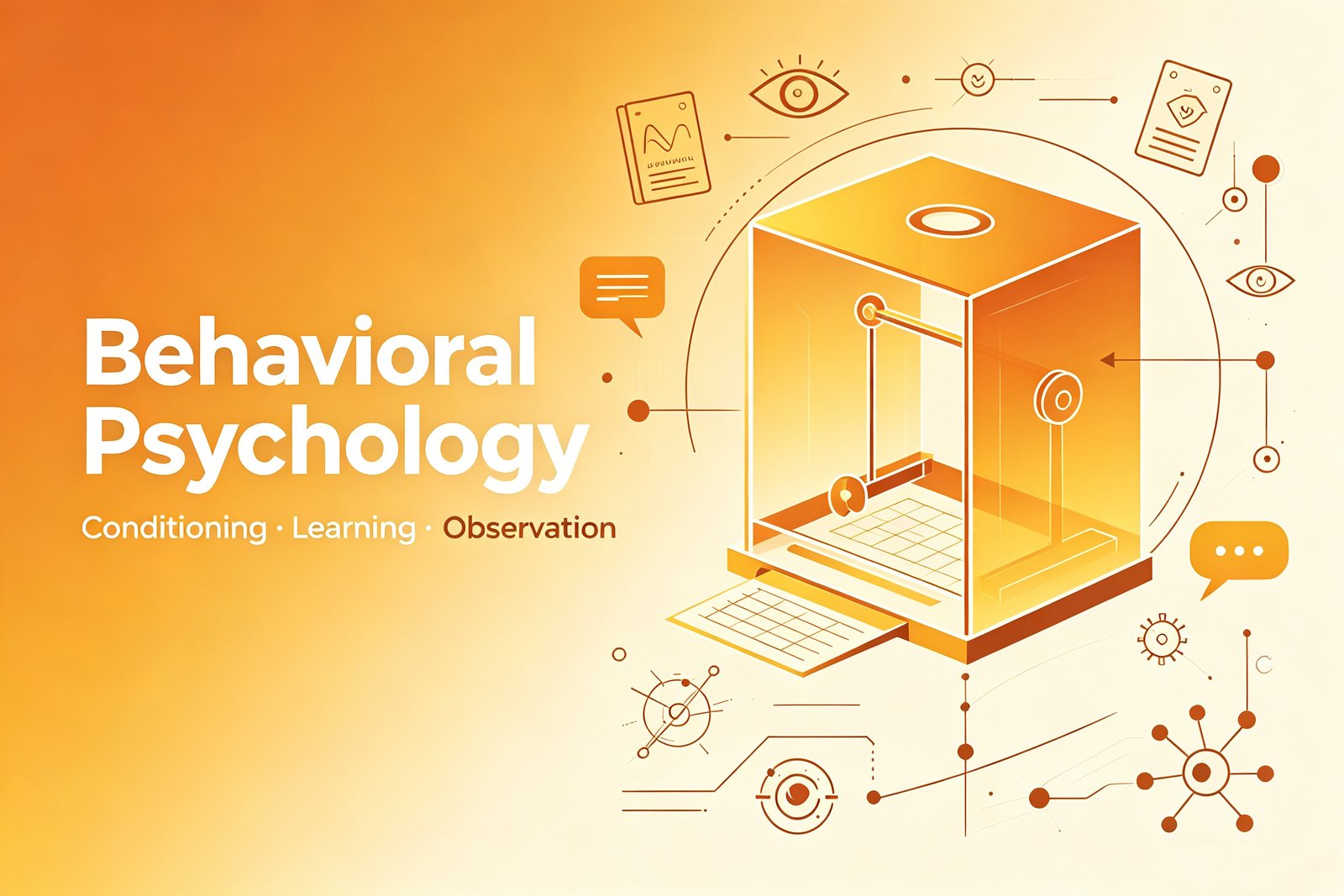
- Ethical Concerns: Early animal experiments (e.g., Skinner Box) and infant studies raised substantial ethical questions.
Contemporary Integrative Trends
Modern psychology no longer views behaviorism as mutually exclusive to other schools but adopts an integrative perspective:
- Biopsychosocial Model: Acknowledging that behavior results from dynamic interactions between biological bases, psychological processes, and social environments.
- Third-Wave Behavior Therapies: Approaches like Acceptance and Commitment Therapy (ACT) and Dialectical Behavior Therapy (DBT) incorporate mindfulness and acceptance principles alongside behavior change techniques, emphasizing psychological flexibility.
Conclusion
By focusing on observable behavior, behavioral psychology established a scientific bedrock for the discipline. Although the “black box” has since been opened—revealing internal workings through cognitive and neuroscience research—the principles of behavior remain fundamental to understanding human functioning. Whether correcting maladaptive behaviors, cultivating new skills, or designing more humane social environments, the logic of behavioral psychology—that behavior is governed by its consequences—remains a powerful tool in our arsenal. Future directions lie in deepening our understanding of the dynamic interplay between behavior, cognition, emotion, and neurobiology to achieve a more comprehensive and empathetic understanding of human nature.
References (Selected)
- Watson, J. B. (1913). Psychology as the behaviorist views it. Psychological Review, 20(2), 158–177.
- Skinner, B. F. (1938). The Behavior of Organisms: An Experimental Analysis. Appleton-Century-Crofts.
- Bandura, A. (1977). Social Learning Theory. Prentice Hall.
- Kazdin, A. E. (2012). Behavior Modification in Applied Settings(7th ed.). Waveland Press.
- Cooper, J. O., Heron, T. E., & Heward, W. L. (2020). Applied Behavior Analysis(3rd ed.). Pearson.