What Is Social Psychology?
Abstract
Social Psychology is the scientific study of how individuals think about, influence, and relate to one another within a social context. Emerging at the intersection of psychology and sociology in the early 20th century, this discipline investigates the power of the situation to shape thoughts, feelings, and behaviors. It examines phenomena ranging from conformity and persuasion to prejudice and altruism. This article provides a professional overview of the historical context, core theoretical frameworks, research methodologies, and contemporary applications of social psychology, highlighting its pivotal role in explaining collective human behavior.
Introduction: The Power of the Situation
For much of psychology’s history, the individual was viewed as a self-contained unit driven by internal drives or personality traits. However, a paradigm shift occurred in the mid-20th century as researchers began to recognize the profound impact of social forces. Landmark events, such as the Holocaust and the Civil Rights Movement, prompted scholars like Kurt Lewin—often被称为 the “father of social psychology”—to argue that behavior is a function of both the person and their environment (B = f(P, E)). This era marked the birth of modern social psychology.
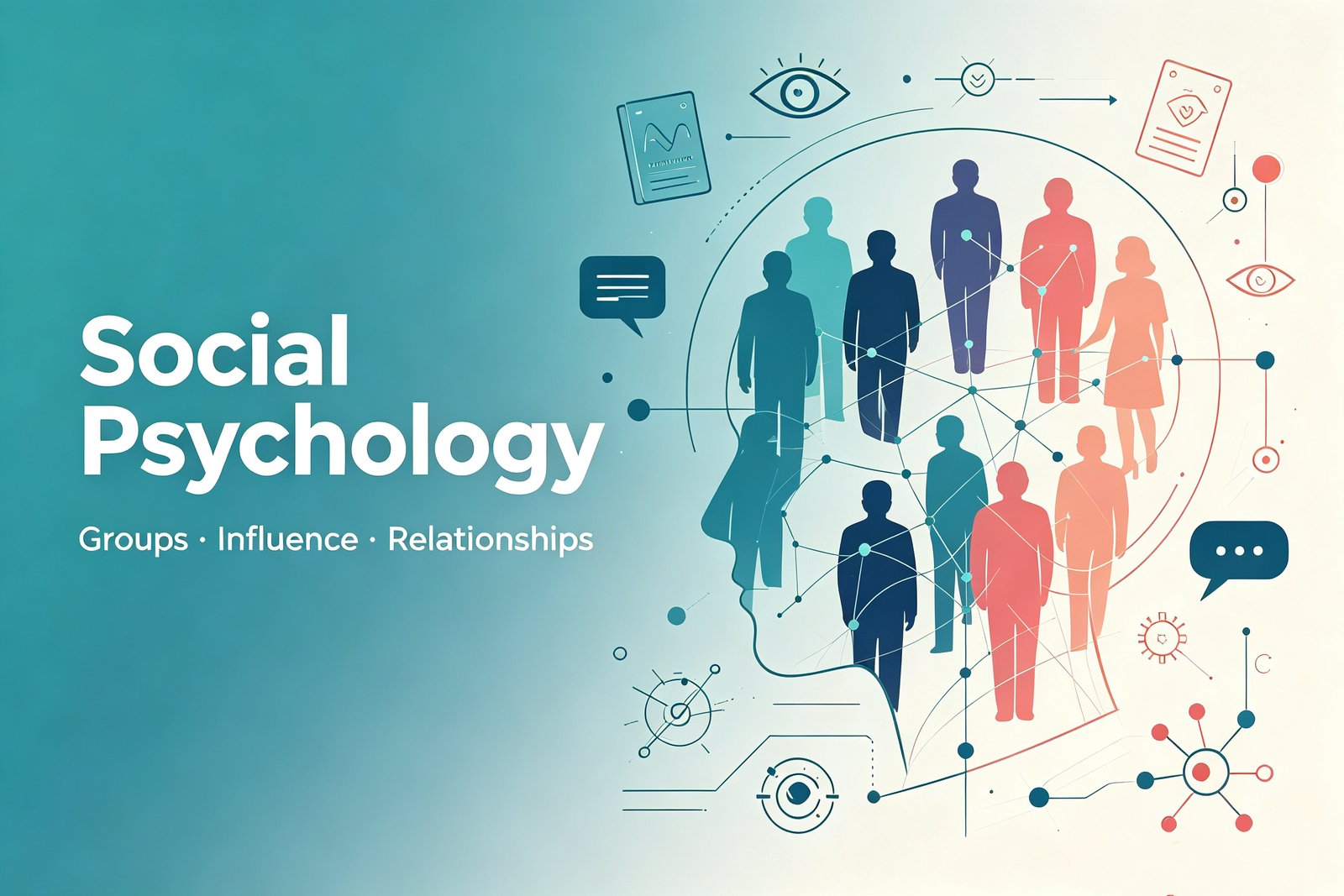
Social psychology treats the individual as a meaning-maker embedded within a complex social web. Analogous to a node in a network, an individual’s cognition and action are constantly modulated by the real, imagined, or implied presence of others. This social-cognitive perspective remains a foundational concept in the field, emphasizing that we do not just react to the world, but interpret it through a social lens.
Core Domains of Study
Social psychology is organized around several interrelated domains concerning the self, social influence, and social relations:
1. Social Cognition
This domain explores how people perceive, remember, and interpret information about themselves and others.
- Key Topics: Attribution Theory (explaining causes of behavior), schemas (mental frameworks), heuristics (mental shortcuts), and cognitive biases.
- The Fundamental Attribution Error: The tendency to overestimate dispositional (personality) factors and underestimate situational factors when explaining others’ behavior.
- Application: Understanding confirmation bias helps explain why people cling to stereotypes despite contradictory evidence.
2. Social Influence
This area examines the ways in which external social pressures alter an individual’s behavior or beliefs.
- Key Models: Solomon Asch’s Conformity Experiments (yielding to group pressure), Stanley Milgram’s Obedience Studies (responding to authority figures), and Philip Zimbardo’s Stanford Prison Experiment (role-playing in institutions).
- Compliance Techniques: Robert Cialdini’s principles of influence, including Reciprocity, Scarcity, Authority, Commitment/Consistency, Liking, and Social Proof.
3. Social Identity and Group Behavior
Focusing on the “we” rather than the “I,” this domain investigates how group membership affects self-concept and intergroup relations.
- Key Theories: Henri Tajfel and John Turner’s Social Identity Theory, which explains how categorizing ourselves into groups (in-groups) leads to favoritism towards our own group and bias against out-groups (out-groups).
- Group Dynamics: The study of phenomena like Group Polarization (groups making more extreme decisions than individuals) and Groupthink (the desire for harmony overriding realistic appraisal).
4. Attitudes and Persuasion
This domain explores the formation, structure, and change of attitudes, as well as the effectiveness of persuasive messages.
- Key Models: The Elaboration Likelihood Model (ELM) by Petty and Cacioppo, which describes two routes to persuasion: the central route (careful consideration) and the peripheral route (heuristic cues).
- Cognitive Dissonance: Leon Festinger’s theory that inconsistencies between attitudes and behaviors create psychological tension, motivating individuals to change one to match the other.
5. Prosocial Behavior and Aggression
Investigating the extremes of human interaction, this area looks at why we help others and why we harm them.
- Prosocial: The Bystander Effect and Diffusion of Responsibility (Latane & Darley), explaining why individuals are less likely to help in groups.
- Aggression: Theories distinguishing between hostile (emotional) and instrumental (goal-oriented) aggression, and the influence of frustration, deindividuation, and media violence.
Research Methodologies
Social psychologists employ rigorous experimental and correlational methods to isolate the effects of social variables:
- Laboratory Experiments: The gold standard for establishing causality. Researchers manipulate an independent variable (e.g., presence of an authority figure) to observe its effect on a dependent variable (e.g., obedience rates) in a controlled setting.
- Field Experiments: Conducting experiments in natural settings (e.g., testing helping behavior in a subway) to increase ecological validity.
- Correlational Studies: Using surveys and observations to identify relationships between variables (e.g., correlation between socioeconomic status and implicit bias).
- Meta-Analysis: Statistically combining results from numerous studies to identify robust effects and moderators (e.g., synthesizing findings on gender differences in conformity).
Applications in Professional Practice
1. Health Psychology and Public Health
Social psychology informs health campaigns by utilizing persuasion models to encourage vaccination, smoking cessation, and safe sex practices. Concepts like the Theory of Planned Behavior are used to predict and change health-related behaviors.
2. Business and Organizational Management
Understanding group dynamics and leadership styles improves team performance and reduces workplace conflict. Principles of social influence are applied in marketing, negotiation, and consumer behavior analysis.
3. Law and Criminal Justice
The study of eyewitness testimony reliability, jury decision-making, and implicit racial bias is crucial for ensuring fair trials. Research on dehumanization helps explain the psychology behind hate crimes and police brutality.
4. Environmental Sustainability
Social norms marketing (highlighting what most people do) is used to encourage pro-environmental behaviors like recycling and energy conservation. Appeals to social responsibility increase compliance with conservation efforts.
Limitations and Contemporary Directions
While powerful, the field faces ongoing scrutiny:
- The Replication Crisis: Many classic studies (e.g., ego depletion, some priming effects) have failed to replicate, leading to increased emphasis on open science, pre-registration, and larger sample sizes.
- Cultural Bias: Much early research was conducted in Western, Educated, Industrialized, Rich, and Democratic (WEIRD) societies. Current research emphasizes cross-cultural social psychology to determine if effects like the Fundamental Attribution Error are universal or culturally bound.
- System Justification: Modern theories explore how people rationalize and defend existing social, economic, and political systems, even when those systems disadvantage them.
Today, social psychology is increasingly integrated with Social Neuroscience (using fMRI to study the neural basis of prejudice and empathy) and Behavioral Economics (studying how social preferences affect economic decisions).
Conclusion
Social psychology has transformed our understanding of human nature from that of an isolated thinker to a fundamentally social animal. By dissecting the mechanisms of conformity, persuasion, and group conflict, it provides the blueprint for addressing societal challenges ranging from discrimination to climate change. As computational modeling and big data analytics advance, the dialogue between social psychology and technology will continue to illuminate how digital environments reshape our social selves.
References (Selected)
- Allport, G. W. (1954). The Nature of Prejudice. Addison-Wesley.
- Asch, S. E. (1956). Studies of independence and conformity: I. A minority of one against a unanimous majority. Psychological Monographs, 70(9), 1–70.
- Cialdini, R. B. (2006). Influence: The Psychology of Persuasion(Rev. ed.). Harper Business.
- Milgram, S. (1974). Obedience to Authority: An Experimental View. Harper & Row.
- Tajfel, H., & Turner, J. C. (1979). An integrative theory of intergroup conflict. In W. G. Austin & S. Worchel (Eds.), The Social Psychology of Intergroup Relations(pp. 33–47). Brooks/Cole.