What Is Developmental Psychology?
Abstract
Developmental Psychology is the scientific study of systematic changes and continuities in human behavior, cognition, and emotion across the entire lifespan—from conception to death. Emerging in the late 19th century and solidified through the mid-20th century, this discipline investigates the complex interplay between biological maturation (nature) and environmental experience (nurture). This article provides a professional overview of the historical context, core domains, research methodologies, and contemporary applications of developmental psychology, highlighting its pivotal role in understanding the architecture of human development.
Introduction: The Lifespan Revolution
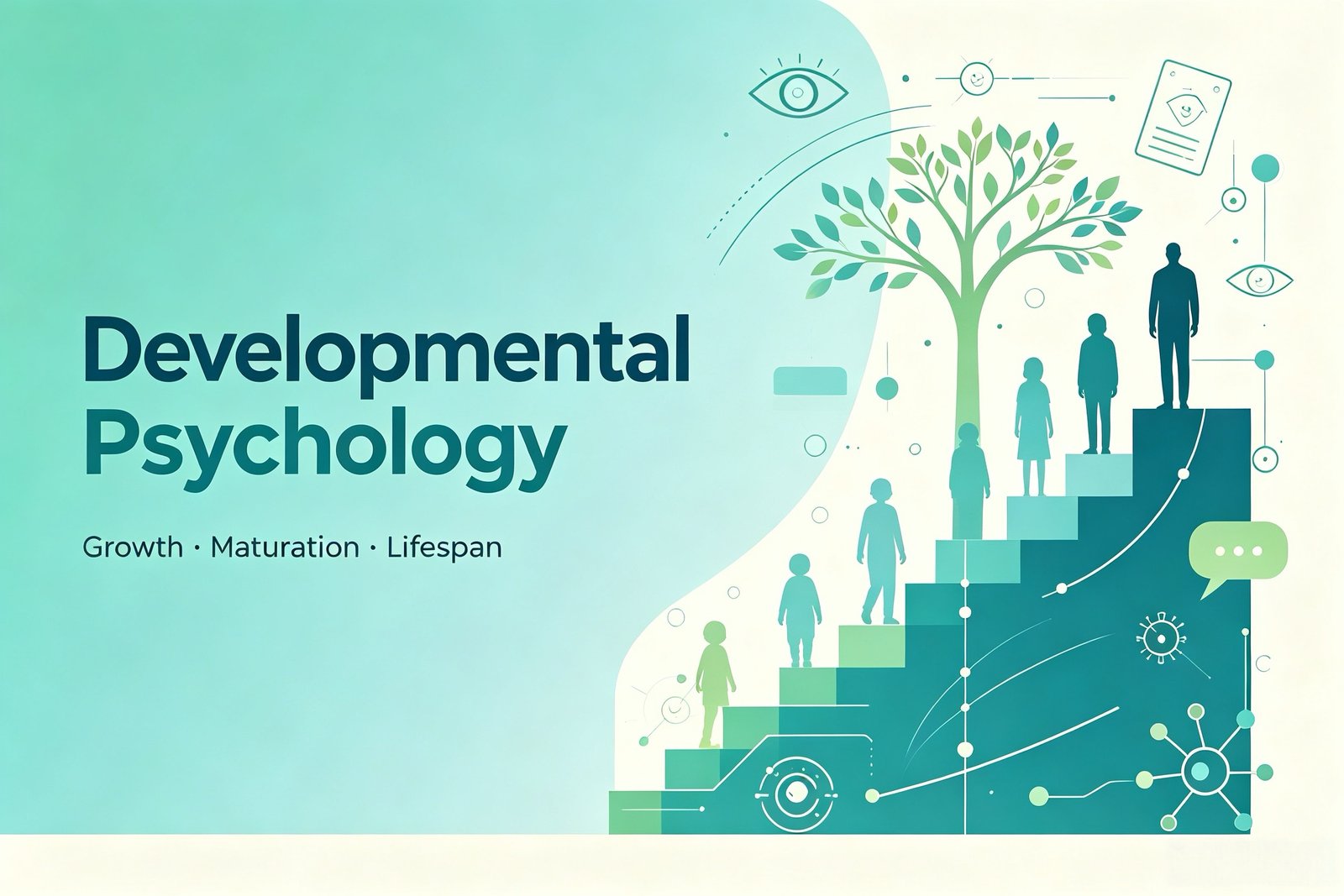
For much of the early 20th century, psychology focused predominantly on child development, operating under the assumption that personality was largely fixed by early childhood. However, a paradigm shift known as the Lifespan Perspective began to take hold, championed by scholars like Paul Baltes. This perspective argues that development is not finished in youth but continues throughout adulthood and aging. It posits that development is lifelong, multidimensional, multidirectional, and highly plastic. Unlike earlier views that treated childhood as the only significant period, contemporary developmental psychology views the individual as a dynamic system continuously adapting to internal biological clocks and external socio-historical contexts.
Developmental psychology treats growth as a continuous interaction between the organism and its environment. Much like a computer processes data based on its hardware (biology) and software (experience), humans develop through the constant exchange between genetic predispositions and contextual influences. This interactionist metaphor remains a foundational concept in the field.
Core Domains of Study
Developmental psychology is organized around several interrelated domains:
1. Physical Development
Physical development involves the biological changes in body and brain structure. It bridges the gap between genetic blueprints (nature) and health/nutrition (nurture).
- Key Topics: Brain plasticity, motor skill acquisition (gross and fine), puberty, menopause, and the process of senescence (aging).
- Application: Understanding critical periods for neural pruning helps explain why early intervention in cases of deprivation (e.g., language exposure) is crucial for later cognitive functioning.
2. Cognitive Development
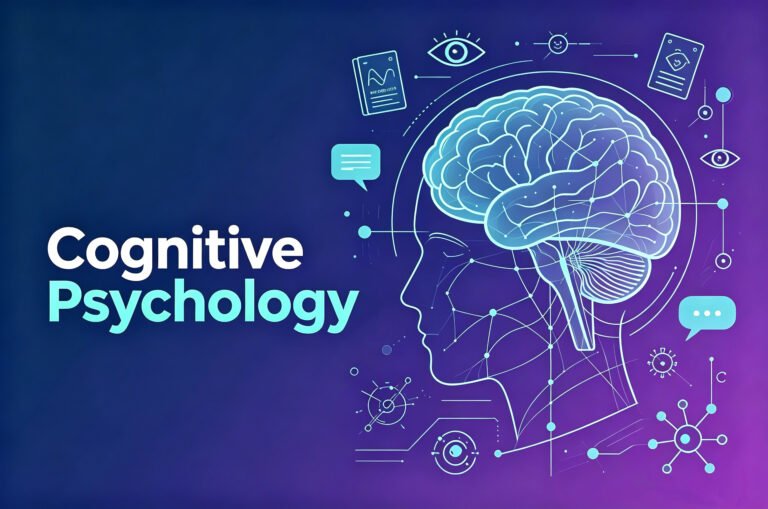
This domain explores how mental processes such as memory, problem-solving, and intelligence evolve over time.
- Key Models: Jean Piaget’s stage theory (Sensorimotor to Formal Operational), Lev Vygotsky’s Sociocultural Theory (Zone of Proximal Development), and Information Processing Theory.
- Theory of Mind: The ability to attribute beliefs, desires, and intentions to oneself and others, typically developing around age four, which allows for complex social navigation.
3. Social-Emotional Development
This area focuses on how individuals form relationships, manage emotions, and construct their sense of self.
- Key Models: John Bowlby and Mary Ainsworth’s Attachment Theory (identifying Secure, Anxious-Ambivalent, and Avoidant attachment styles) and Erik Erikson’s stages of psychosocial development.
- The Strange Situation: A controlled observational technique used to assess the security of attachment between an infant and caregiver.
4. Language Development
Developmental psychologists study how humans acquire the capacity to perceive, produce, and use words to understand and communicate.
- Key Concepts: Phonology, morphology, syntax, semantics, and pragmatics.
- Theories: The debate between Noam Chomsky’s Nativism (Universal Grammar is innate) and Empiricism (language is learned through statistical learning and reinforcement).
5. Moral Development
This domain examines the evolution of moral reasoning and ethical decision-making.
- Key Models: Lawrence Kohlberg’s stages of moral development (Pre-conventional to Post-conventional) and Carol Gilligan’s critique emphasizing the “ethics of care.”
- Application: Understanding moral reasoning helps educators design character education programs and assists legal systems in evaluating culpability.
Research Methodologies
Developmental psychologists employ a variety of methods to infer developmental processes while adhering to strict ethical standards:
- Longitudinal Studies: Following the same group of individuals over extended periods (e.g., the Dunedin Study). This allows researchers to track individual trajectories but is costly and prone to participant attrition.
- Cross-Sectional Studies: Comparing different age groups at a single point in time. This method is efficient but cannot distinguish between age effects and generational (cohort) effects.
- Sequential Designs: Combining longitudinal and cross-sectional methods to mitigate the weaknesses of both approaches.
- Neuroimaging: Using fMRI and EEG to observe brain activity during developmental tasks, helping to map cognitive functions onto specific neural maturation patterns.
Applications in Professional Practice
1. Education and Pedagogy
Insights into cognitive readiness and Vygotsky’s Zone of Proximal Development inform differentiated instruction. Understanding working memory limitations in young children has led to strategies such as “scaffolding” and “chunking” information to enhance learning outcomes.
2. Clinical and Counseling Psychology
Developmental frameworks inform interventions for behavioral disorders in children (e.g., ADHD, Autism Spectrum Disorder) and address adult issues such as identity crises in adolescence or depression in late adulthood. Attachment theory is widely used in family therapy to repair relational bonds.
3. Social Policy and Public Health
Research on adolescent brain development—specifically the slower maturation of the prefrontal cortex relative to the limbic system—has influenced juvenile justice reform by advocating for reduced culpability. Prenatal development research guides public health policies regarding maternal nutrition and substance abuse.
4. Gerontology and Aging
As populations age, developmental psychology contributes to “successful aging” initiatives. Research into cognitive reserve helps design interventions (e.g., lifelong learning, physical exercise) to delay the onset of dementia and maintain quality of life in late adulthood.
Limitations and Contemporary Directions
While powerful, traditional developmental theories have faced critiques:
- Cultural Bias: Many classic theories (e.g., Piaget’s, Kohlberg’s) were based on Western, Educated, Industrialized, Rich, and Democratic (WEIRD) samples, raising questions about the universality of developmental stages.
- Nature-Nurture Integration: Modern epigenetics demonstrates that environmental factors can modify gene expression without changing the DNA sequence itself, challenging simplistic dichotomies between genes and environment.
- Dynamic Systems Theory: A newer perspective suggests that development arises from the self-organization of multiple interacting components (brain, body, physical environment) rather than following a rigid genetic program.
Today, developmental psychology is increasingly integrated with Cultural Psychology (examining how cultural practices shape developmental pathways) and Affective Neuroscience (studying how emotions regulate developmental transitions).
Conclusion
Developmental psychology has transformed our understanding of the human journey from a simple linear progression into a complex, dynamic system of growth and adaptation. By dissecting the mechanisms of learning, attachment, and reasoning across the lifespan, it provides the blueprint for understanding human potential. As technology advances, particularly in neuroimaging and genetics, the dialogue between developmental psychology and these fields will continue to illuminate the intricate workings of how we become who we are.
References (Selected)
- Baltes, P. B. (1987). Theoretical propositions of life-span developmental psychology: On the dynamics between growth and decline. Developmental Psychology, 23(5), 611–626.
- Bowlby, J. (1969). Attachment and Loss: Vol. 1. Attachment. Basic Books.
- Piaget, J. (1952). The Origins of Intelligence in Children. International Universities Press.
- Vygotsky, L. S. (1978). Mind in Society: The Development of Higher Psychological Processes. Harvard University Press.
- Berk, L. E. (2022). Development Through the Lifespan(8th ed.). Pearson.