
What Looks Like Everyday Behavior Might Actually Be Your Body Crying for Help
Do you often find yourself scrolling through those viral videos labeled “ASMR for OCD” or “Extreme Satisfaction for Perfectionists”?
In popular culture, Obsessive-Compulsive Disorder has been reduced to a quirky, even adorable personality trait—an obsession with cleanliness, symmetry, and tiny details. To many, it’s become shorthand for being disciplined, refined, and a little bit “extra.”
But for those actually living with OCD, there is nothing cute about it.
David Beckham once opened up in his documentary about years of silent suffering.
He would compulsively count his clothes. He arranged magazines according to the straight lines and symmetrical patterns on their covers. At night, only after his wife and children were asleep, he would begin cleaning—scrubbing until every surface was spotless, every object perfectly aligned, and everything displayed in even numbers.
Yet, instead of concern, most comments focused on how “lucky” Victoria was to have such a tidy, devoted husband.
The truth is, OCD isn’t about liking things neat.
It’s about needing them to be—because the alternative feels unbearable.

Obsessive-Compulsive Disorder (OCD) is a mental health condition marked by obsessions—intrusive thoughts, images, urges, fears, or worries—and compulsions, which are repetitive behaviors or mental acts performed to reduce the distress caused by those obsessions.
For those living with OCD, the mind becomes a trap.
They are haunted by specific thoughts, mental images, impulses, or relentless anxieties—circling the same fears again and again.
Trapped in this internal loop, they may find themselves:
- Repeating certain movements or gestures
- Touching objects in rigid patterns
- Checking locks, switches, or appliances endlessly
- Mentally reviewing or confessing to perceived mistakes
- Rereading the same sentence or rewriting letters to “get them right”
- Washing, scrubbing, disinfecting until skin is raw
- Counting, arranging, and aligning objects with unnatural precision
- Throwing things away—or hoarding them—under rigid rules
OCD forces people into cycles of behavior that feel meaningless yet unbearably urgent.
They know the rituals don’t make logical sense. They want to stop. But without intervention, the urge overrides reason, again and again.
Symptoms can range from mild to severe. Left untreated, OCD can erode a person’s ability to work, study, maintain relationships, and carry out even the simplest routines of daily life.
It is not quirkiness. It is not charming. It is not a personality trait.
It is a serious psychiatric condition—one that deserves understanding, not admiration.

OCD Is Not Just About Being “Too Clean”
The most common misunderstanding about Obsessive-Compulsive Disorder is reducing it to a love of tidiness or a “clean freak” personality.
But for those truly struggling with OCD, it’s never about enjoying cleanliness—it’s about being driven by fear.
One person described celebrating because their shower lasted “only” an hour and a half:
“My shower time is finally down to 90 minutes instead of over two hours! I’m making progress!”
For some, the ritual goes far beyond washing.
Before touching anything, they must disinfect every surface first—then whisper a silent mantra in their mind: “I am clean. I am clean.”
In Ethiopia, a girl named Bella did something that sounds unbelievable: she ate her own home—one bite at a time.
She knew she shouldn’t be thinking about that wall. She knew it made no sense. But the thought wouldn’t leave her alone. And the only way to silence it—if only for a moment—was to chew through it.
By the age of 17, Bella had eaten roughly eight square meters of her house.
Unsurprisingly, her body paid the price. Parasites infested her stomach. Hospital visits became routine. It wasn’t until a psychologist diagnosed her with Obsessive-Compulsive Disorder that anyone understood what was really happening.
For Bella—and for millions like her—OCD is not a quirky personality trait.
It’s not about being “disciplined” or “aesthetic.”
It’s a mental prison. A weight heavy enough to collapse an entire life under its pressure.

The Real Torture of OCD Isn’t Cleaning—It’s Intrusive Thoughts
Intrusive thoughts are involuntary, repetitive, and distressing ideas or images that invade the mind without warning—and against a person’s will. They often take the form of catastrophe, violence, contamination, shame, or morally disturbing scenarios.
People with OCD don’t want these thoughts. They are forced upon them—relentlessly, mercilessly—by their own brains.
This kind of mental torment is almost impossible for outsiders to imagine.
Some patients describe a constant, inescapable “noise” inside their heads:
“Whether it’s the TV, gameplay videos, or any sound at all—I musthave background noise at all times. Otherwise, I’ll be swallowed whole by the static in my own mind.
If everything is quiet, I start to panic. I can only truly relax when I’m completely absorbed in a game or a book—when I can drown myself in something else.”
For them, silence isn’t peace.
It’s a vacuum—one that fills instantly with fear, doubt, and mental chaos.
And so, the rituals begin: the washing, the counting, the checking, the endless distractions. Not because they enjoy them—but because they’re the only lifelines strong enough to keep the thoughts at bay, if only for a little while.

For some, intrusive thoughts don’t just bring discomfort—they unleash full-scale disasters inside the mind.
“The moment I get into a car, my brain is convinced I’m going to die in a horrific accident.
I see trees crashing down on top of me. I see myself in a crash, not wearing a seatbelt, the car exploding into flames, hit by a derailed train…
So far, I’ve avoided driving. I walk, cycle, or take public transport instead.”

For those living with OCD, the loss of control isn’t limited to thoughts or habits—it spreads, slowly but relentlessly, into every corner of life.
One woman described what it really means to live with the disorder:
“I have OCD, mainly centered around symmetry and intrusive thoughts.
And I don’t just mean havingintrusive thoughts—I mean my brain latches onto something awful and refuses to let go. Unless I perform a ritual—like wiping down the table over and over—I simply cannot get the thought out of my head.”
Before starting therapy, she would lie awake night after night, trapped in horrifying mental images—drowning, being violated, coming to harm.
Cleaning the house was the only thing that gave her a fragile sense of safety.
“If I didn’t clean before bed, I would become convinced that something unspeakably violent was going to happen to me.
People think OCD is about being tidy. But it’s not. It’s about being forced to do things—at the cost of sleep, health, relationships, even work.
It destroys lives.”
And perhaps the cruelest part?
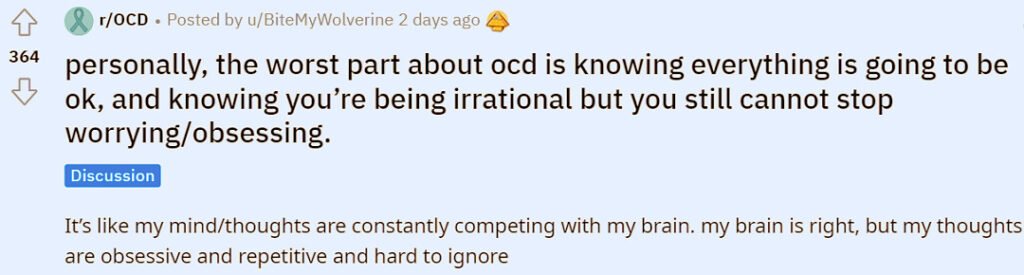
They know. They know the fear is irrational. They know the rituals make no logical sense.
“The worst part of OCD, for me, is knowing deep down that everything is probably fine—and still not being able to stop. It’s like being possessed by your own fear.”
This is the side of OCD that doesn’t make it into Instagram reels or “oddly satisfying” edits.
Not perfectionism. Not aesthetics.
Just a mind at war with itself—and a life slowly slipping out of reach.
OCD Doesn’t Just Scare You—It Lies to You
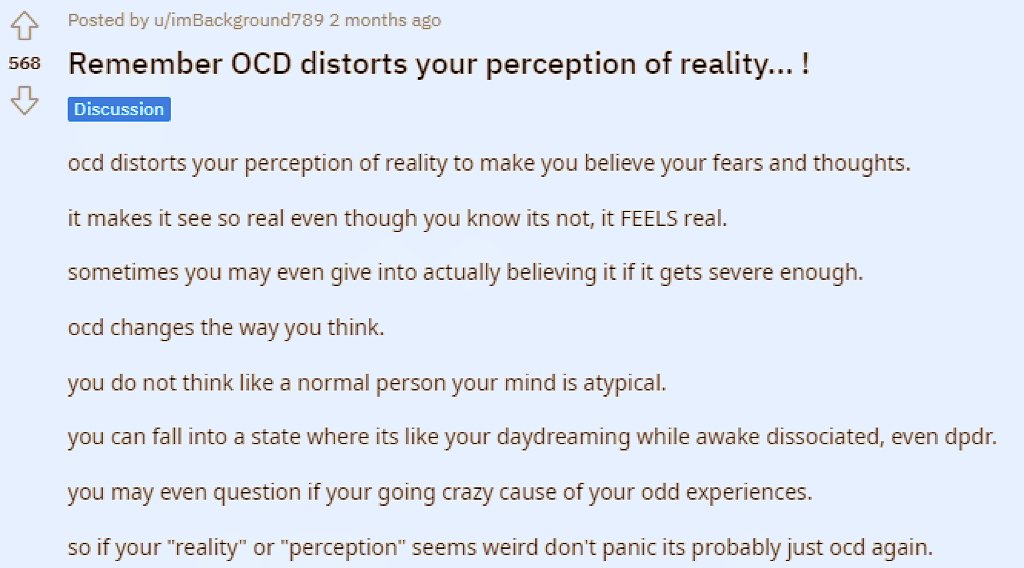
Another terrifying aspect of Obsessive-Compulsive Disorder is how it distorts your perception of reality—convincing you that your fears are not only valid, but true.
The dread feels devastatingly real, even when—on some level—you know it isn’t.
OCD doesn’t just give you unwanted thoughts. It changes how you think.
“You don’t think like other people anymore.
You drift into a state that feels like daydreaming while awake—except it’s filled with fear. There’s this awful sense of detachment, like you’re losing touch with what’s real.
And because it feels so bizarre, you start wondering: Am I going crazy?”
That sense of unreality, that creeping doubt about your own mind—it isn’t madness.
More often than not, it’s OCD pulling the strings.
So if your “reality” starts to feel strange, or your thoughts spiral into territory that seems too weird to share—don’t panic.
It may not be you losing your mind.
It may be OCD, doing what it does best: twisting, manipulating, and isolating.
And if that happens, reaching out for help isn’t a weakness.
It’s how you take your reality—and your life—back.
You’re Not a “Bad Person”—You’re Just Sick
Living with OCD means enduring not only the relentless intrusions and exhausting rituals, but also a brutal inner critic.
For many, the harshest voice isn’t the disorder itself—it’s the one inside their own head.
One online user shared their story:
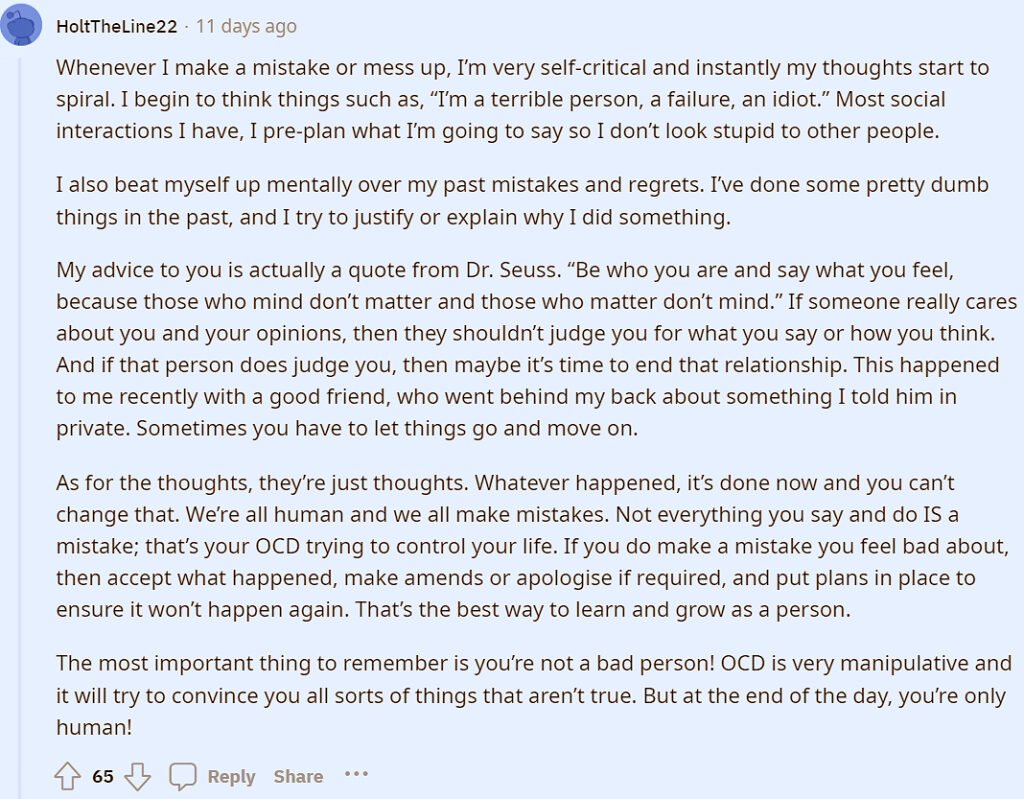
“Every time I mess up or screw something up, I tear myself apart. I start thinking: I’m a terrible person. A failure. Worthless.
I pre-plan almost every social interaction—scripting what I’ll say—just so people won’t think I’m stupid.
I replay old mistakes and regrets on loop, beating myself up for things I can’t change.”
What finally set them free was a simple sentence:
“Be yourself. Say what you really feel. Because the ones who mind don’t matter, and the ones who matter don’t mind.”
Their message to others is this:
If someone truly cares about you, they won’t judge you for your thoughts or the words that slip out.
And if someone does judge you for those things—maybe it’s time to let that relationship go. Sometimes, moving forward means learning to release the people who hold you back.
As for those thoughts?
They’re just thoughts. Not truths. Not prophecies. Just noise.
Whatever happened is over. You can’t rewrite the past—but you can shape what comes next.
If you’ve made a mistake that hurts, own it. Apologize if needed. Make a plan so it doesn’t happen again. That’s what growing up looks like.
And most importantly—remember this: You are not a bad person.
OCD is manipulative. It will try to convince you of things that aren’t true.
But at the end of the day, you’re just a human being—doing your best inside a mind that sometimes fights against you.
When OCD Hides in Plain Sight: The Invisible Subtypes
In his book 《The Man Who Couldn’t Stop》, author David Adam writes:
People with OCD spend an average of six hours a day trapped in obsessive thoughts, and another four hours carrying out compulsive behaviors.
That’s ten hours a day—lost to fear, ritual, and mental exhaustion.
OCD ranks as the fourth most common mental disorder worldwide, following depression, substance abuse, and anxiety disorders.
It is twice as prevalent as autism and schizophrenia combined.
The World Health Organization classifies OCD among the top ten most disabling illnesses—its impact on quality of life is considered even greater than that of diabetes.
And yet—despite how common and devastating it is—most people with OCD wait 10 years or more before seeking help.
Why? Because they are misunderstood.
Dismissed as “quirky.” Labeled “perfectionists.” Told they’re just “too intense” or “overly dramatic.”
Even by themselves. Shame keeps them silent.
They minimize their pain. They hide their rituals. They convince themselves they’re “just difficult” or “hard to love.”
So they suffer in secret—until the disorder has already reshaped their work, their relationships, and their sense of self.
OCD isn’t rare. It isn’t a punchline. And it certainly isn’t a personality trait.
It’s a serious, isolating illness—one that too many people endure alone, simply because no one told them it was okay to ask for help.

Is It Possible to Turn Off Intrusive Thoughts?
The Short Answer? No. And Here’s Why.
Cognitive Behavioral Therapist Katie d’Ath is clear on this:
You can’t force intrusive thoughts to stop.
Part of what fuels these thoughts is exactly trying to get rid of them.
The more you engage, the more you “fight” them, the more you feed them.
Your effort backfires—blocking the very natural process that would allow the thought to fade on its own.
In fact, most people with OCD perform compulsions precisely to chase those thoughts away.
They wash. They check. They count. They confess.
Not because it makes logical sense—but because, for a moment, it quiets the noise.
But that relief is temporary.
And the cycle begins again.
The harder you push against a thought, the tighter it holds on.
Paradoxically, the path out isn’t more control—it’s learning to stop struggling with the thought at all.

What you can control isn’t whether intrusive thoughts show up—but how you respond to them.
You decide whether to listen to them. Whether to assign them meaning. Whether to let them define you.
So, how do you cope with intrusive thoughts more healthily?
The answer is simple—but far from easy:
Do nothing.
Let the thoughts, images, urges, and sensations come.
And then… let them go.
No wrestling. No analyzing. No debating. Just allowing.
Like breathing.
You don’t consciously make yourself exhale—it happens naturally after you inhale. You don’t have to “try” to let go. You just… do.
This is exactly what Cognitive Behavioral Therapy (CBT) aims to achieve.
A therapist works with you to uncover the distorted thinking patterns—the “OCD schemas”—that cause you to misinterpret information. Then, together, you begin to rewire them.

That process includes:
- Normalizing intrusive thoughts: Everyone has them. They don’t mean you’re broken.
- Releasing self-blame: These thoughts are automatic. You are not responsible for what pops into your head uninvited.
- Identifying and challenging automatic thoughts: Recognizing the snap judgments OCD makes—and questioning their validity.
- Dismantling neutralizing thoughts: Spotting those mental rituals (“If I tap three times, nothing bad will happen”) and learning to sit with uncertainty instead.
- Updating dysfunctional cognitive schemas: Softening the rigid, catastrophic beliefs that fuel OCD.
Right now, the most effective approach is to seek help from qualified professionals in reputable clinical settings.
Clinically, CBT, psychodynamic therapy, and Morita therapy are commonly used.
Among these, CBT is considered the gold standard for treating OCD, particularly the two core techniques:
- Thought Stopping / Blocking: Learning to interrupt rumination without feeding it.
- Exposure and Response Prevention (ERP): Gradually facing feared situations without performing compulsions—training your brain to tolerate uncertainty.
You can’t stop the waves.
But you can learn how to surf.